Bridging the Gap: A Medical Professional’s Perspective on Clinical MassageReview: Deep Tissue Massage Course at RSM International Academy
Making a career shift in your 40s is never a decision taken lightly. As a medical professional looking to transition from a clinical hospital setting into private manual therapy, I was skeptical about attending a massage school. I feared the curriculum would be too "soft" or lack the physiological rigor I was used to.
I entered the Deep Tissue Massage Course at RSM International Academy having already completed their Trigger Point Therapy module. I stayed because RSM is the only school I found that speaks the language of evidence-based medicine rather than vague "intuition."
Anatomy and Pathology: Beyond the Basics
Coming from a medical background, I have little patience for incorrect terminology. What impressed me immediately was the depth of the anatomical instruction. We didn't just cover standard anatomy basics for massage students; we dissected the biomechanics of movement.
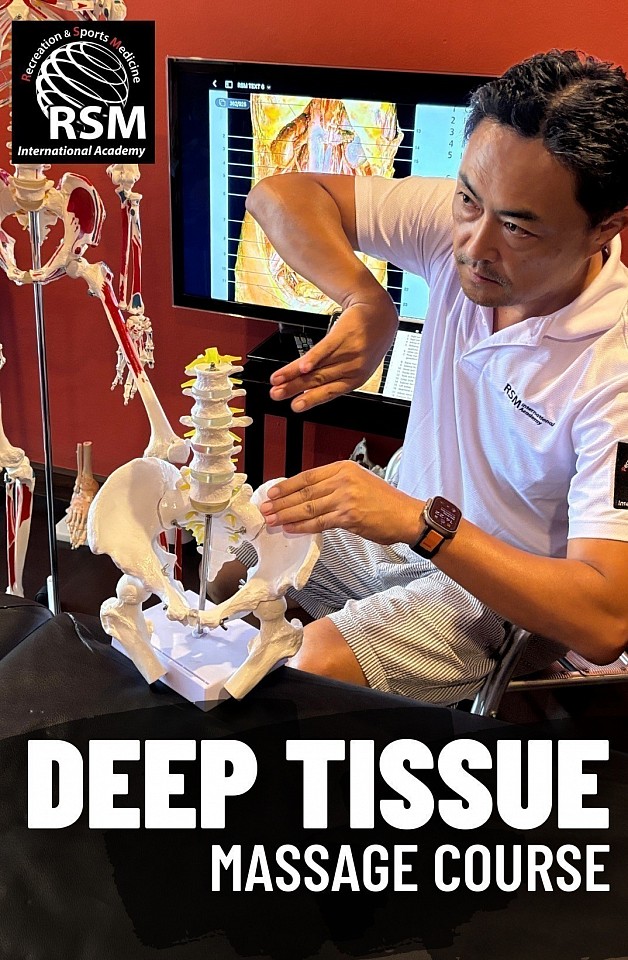
Using over 500 detailed clinical images, we analyzed posture not as a static concept, but as a chain of compensations. We looked at how pelvic anterior tilt compresses the lumbar facets and how thoracic rigidity compromises the cervical spine. For a physiotherapist, this visual and practical approach bridged the gap between theoretical pathology and hands-on treatment perfectly.
Sustainability for the Mature Practitioner
One of my primary concerns entering this field later in life was physical longevity. I cannot afford to burn out my joints with poor mechanics.
The course placed a heavy emphasis on developing effective pressure techniques that rely on body weight transfer and skeletal stacking rather than muscular force. This was a revelation. I learned that deep tissue work, when done correctly, requires patience and sinking, not brute strength. This ergonomic approach is one of the most essential tools for massage therapists, especially for those of us starting a second career who need to protect our own bodies while delivering results.
Clinical Reasoning and Injury Management
The training was highly relevant to the musculoskeletal issues I plan to treat. We focused extensively on common injuries treated by deep tissue massage, from IT band syndrome and piriformis-related sciatica to complex cervical dysfunctions.
Instead of a generic full-body routine, we learned the importance of addressing specific muscle groups based on assessment. We analyzed the kinetic chain to understand why we were treating the hip to fix a knee, or the chest to fix a neck. This logical, problem-solving method felt very familiar to my medical training, yet it offered a tactile solution I hadn't been able to provide before.
Defining the Scope of Practice
The course also provided much-needed clarity on the differences between massage modalities. It helped me understand exactly where Deep Tissue fits into a treatment plan versus Trigger Point Therapy or Myofascial Release. It wasn't just about learning strokes; it was about clinical decision-making.
Furthermore, the curriculum highlighted that establishing rapport with clients is about more than just bedside manner—it is about professional education. Being able to explain the physiological "why" to a client creates a partnership in recovery, which is the cornerstone of any successful practice.
A Standard You Can Trust
The lead instructor, Hironori Ikeda (MSc Sports Medicine), brings a level of academic and clinical authority that is rare in this industry. Studying alongside other physiotherapists and national team coaches confirmed that this was not a standard "spa" training.
For any medical professional or mature career changer looking for serious clinical massage education, RSM International Academy is the gold standard. It respects your intelligence, protects your body, and gives you the skills to treat with genuine purpose.